
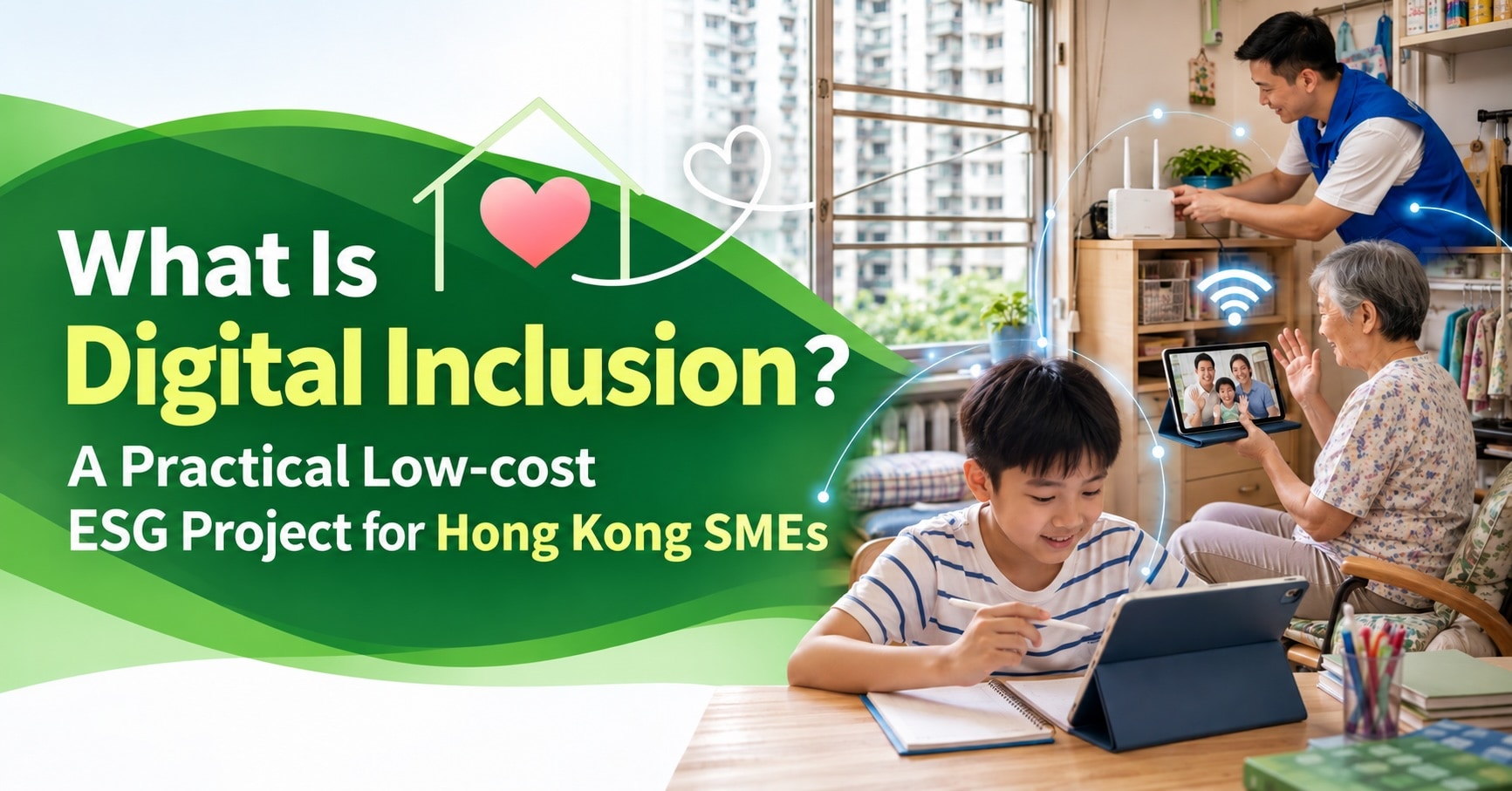
“Digital inclusion” may sound like a policy term, but for many low-income families, elderly people and students in Hong Kong, it is a very practical everyday issue. Can the family access stable internet at home? Can a child attend online lessons and submit homework smoothly? Can an elderly person video call family members, use digital government services and learn basic cyber safety?
As society relies more heavily on digital services, people without stable connectivity are more likely to be excluded from learning, work, information and social connection. This is the problem digital inclusion aims to address.
For Hong Kong enterprises, especially SMEs, digital inclusion is also a highly practical ESG topic. It does not require large infrastructure projects or necessarily a large budget. Yet it can directly respond to the needs of low-income families and vulnerable groups, while making outcomes relatively easy to measure.
What Is Digital Inclusion?
Digital inclusion means enabling people of different ages, abilities, income levels, languages and living backgrounds to access and benefit from digital technology. It is not only about owning a smartphone or having internet access. It also includes:
- Affordable network services
- Suitable devices and connectivity equipment
- Basic digital skills
- The ability to use online and electronic services safely
- Accessible and user-friendly digital content
The Digital Policy Office in Hong Kong promotes various digital inclusion measures to help those in need, especially the elderly, understand and use digital technology products and services. These measures include community digital support stations, outreach programmes, technical support, basic training, enriched ICT training and digital accessibility promotion.
Why Does Hong Kong Still Need Digital Inclusion?
Hong Kong has a high overall internet penetration rate, but high penetration does not mean everyone can use digital services consistently and effectively. According to the Census and Statistics Department’s Thematic Household Survey Report No. 80, 96.6% of households had internet access at home in 2023. The rate of persons aged 10 and over who had used the internet during the 12 months before enumeration was 96.0%. Among persons aged 65 and over, the rate increased from 81.8% in 2022 to 84.2% in 2023.
These figures show that Hong Kong is highly digitalised. They also remind businesses that those who are still unable to connect or use digital services effectively may be the people who need support most. For low-income families, home broadband, mobile data, routers and devices can still be a real financial burden. For elderly people living alone or ethnic-minority communities, a lack of assistance can also make online services harder to use.
Why Is Digital Inclusion a Suitable ESG Project for SMEs?
1. The Cost Is Clearer
Compared with major environmental engineering works, full carbon audits or long-term consultancy programmes, the unit cost of a digital inclusion project is often easier to estimate. Under Global Call’s Low-income Families Network Support Programme, an enterprise can directly sponsor one low-income family with HK$3,688, or support two low-income families at zero additional cost through a designated monthly plan.
2. Outcomes Are Easier to Measure
Companies can clearly record the number of families supported, service duration, equipment provided and beneficiary groups. These details are more useful for ESG, CSR, customer presentations and brand communication than broad statements about caring for the community.
3. The Social Value Is Easy to Understand
Stable internet access directly affects student learning, elderly social connection, access to family information and basic digital service usage. Customers, employees and partners can quickly understand the value of the project.
4. It Naturally Connects with Communications and Technology Services
For telecommunications, IT, office services, education, retail, property management and professional services companies, digital inclusion can connect naturally with daily business. The company is not simply donating money; it is using its own resources and network to support the community.
5. It Can Be Sustained
One-off activities are easy to forget. A two-year connectivity support package can create more sustained impact for students and families. Enterprises can also continue or expand participation each year, gradually building a stronger ESG record.
A Practical Digital Inclusion Project: Supporting Home Wi-Fi for Low-income Families
The Low-income Families Network Support Programme, launched by Global Call in collaboration with a registered charitable organisation, addresses a practical digital inclusion need by bringing stable home connectivity to families in need.
Each beneficiary family receives:
- One 4G SIM-card router
- Two years of unlimited-data home Wi-Fi service
- Distribution arranged by a registered charitable organisation
Beneficiary groups include:
- Low-income families with children
- Subdivided-unit households
- Single-parent families
- Elderly people living alone
- Ethnic-minority families
How Can Enterprises Participate?
| Participation method | Enterprise arrangement | Beneficiary outcome |
|---|---|---|
| Direct sponsorship | HK$3,688, donation receipt available | 1 low-income family benefited |
| Designated monthly plan | Zero additional cost with a 36-month contract | 2 low-income families benefited |
Participating enterprises can receive a certificate of appreciation and an ESG data report. The donation can be made jointly under the name of the enterprise and Global Call Group. These records can support corporate social responsibility communication, customer engagement and sustainability documentation.
What ESG Value Can Digital Inclusion Create?
For Students: Reducing Learning Gaps
Stable Wi-Fi supports online lessons, digital learning materials, homework platforms and research, helping students from low-income families avoid falling behind because of insufficient connectivity.
For Families: Reducing Telecommunications Expenses
Two years of unlimited-data home Wi-Fi can reduce pressure on household connectivity costs, allowing families to allocate limited resources to other essential needs.
For the Elderly: Bridging Social Distance
Elderly people can stay connected through video calls, messaging, online information and electronic services, reducing isolation and digital exclusion.
For Enterprises: Building a Measurable Community Record
Companies can include participation outcomes in ESG or CSR records, including the number of families supported, support package, service period, charitable partner and project report.
Three Tips for SMEs Starting a Digital Inclusion ESG Project
Tip 1: Choose Sustained Support Instead of a One-off Activity
Connectivity support that lasts only a few weeks has limited impact. A two-year service period better supports student learning and daily family use, and is also more suitable for ESG outcome records.
Tip 2: Keep Quantitative Records
After participating, companies should retain donation receipts, certificates of appreciation, number of beneficiary families, support details and ESG data reports. These records can be useful for company profiles, tender documents, customer presentations and annual reviews.
Tip 3: Connect the Community Story with Brand Values
If a company values communications, technology, education, community service or customer trust, digital inclusion can become a natural brand story. The point is not to turn community action into advertising, but to clearly explain how the company uses its capabilities to solve a community problem.
FAQ
Q1: Does digital inclusion simply mean donating computers? No. Digital inclusion covers connectivity, devices, skills, safety and accessibility. For many families, stable home Wi-Fi is the most basic and practical first step.
Q2: Can SMEs with limited budgets still participate? Yes. Digital inclusion projects can start small. As long as the support is clear and outcomes can be recorded, SMEs can gradually build a practical ESG foundation.
Q3: How can a company communicate its participation externally? Companies can explain the participation method, beneficiary groups, support package and charitable partner through websites, social platforms, company profiles, customer newsletters or ESG/CSR summaries.
Contact Us
Looking for an ESG action in 2026 that is practical, clear in cost and meaningful to the community? Contact Global Call to learn how the Low-income Families Network Support Programme can help your company participate in digital inclusion.
Or complete the contact form below to get in touch with our team.
Reference Sources
- Digital Policy Office: Digital Inclusion
- Thematic Household Survey Report No. 80 published
- Digital Policy Office: IT Usage and Penetration Survey
- Inland Revenue Department: List of Tax-exempt Charities
- Global Call: About Us
The above information is for general reference only. ESG reporting, ratings and disclosure requirements should be handled according to each company’s actual circumstances and professional advice.